
Kootenay-Rockies candidates participate in all-candidates forum
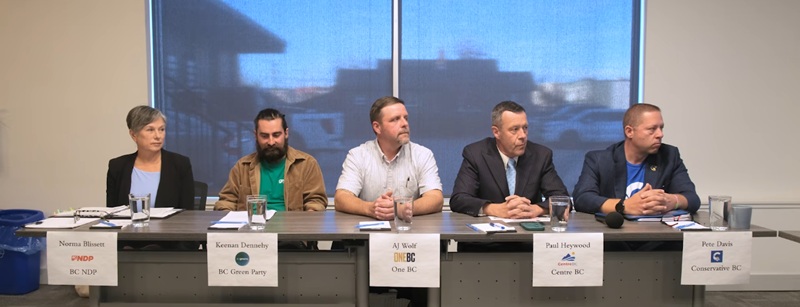
Kootenay-Rockies all candidate forum. (Image Credit: Artistic Media Productions - YouTube)
All five candidates running in Kootenay-Rockies discussed homelessness, community safety and other issues at a digital all-candidates forum ahead of the provincial election.
JCI Kootenay, the Cranbrook Chamber of Commerce and Artistic Media Productions partnered to present the forum.
Residents were invited to submit questions to JCI Kootenay and the Cranbrook Chamber of Commerce before the Oct. 18 recording.
Taking part were Norma Blissett (BC NDP), incumbent Pete Davis (Conservative Party), Keenan Dennehy (BC Green Party), Paul Heywood (CentreBC) and AJ Wolfe (OneBC).
Candidates introduced themselves and explained why they were running before answering questions submitted by the public.
Topics included homelessness, B.C.’s deficit, increasing forestry and mining revenue, the Declaration on the Rights of Indigenous Peoples Act, minimum nurse-to-patient ratios, confidence in the riding’s economy, SOGI 123 resources and how to ensure the riding’s concerns are heard.
Candidates were asked how their parties would reduce homelessness and improve community safety.
Dennehy said the BC Green Party plans to restart the community housing fund.
“Homelessness and safety are part of a larger issue – this is ultimately cost of living. Nobody chooses to be homeless. Nobody chooses to commit crimes. These are acts of desperation. These are people without other options,” said Dennehy.
“So, to address that, the Greens will restart the community housing fund that the NDP cancelled and therefore bring nonprofit housing back to communities and build more homes in that way, so that people have a place to live that they can afford.
“Additionally, 20 public grocery stores with core basket goods 30 per cent less. That means people can feed themselves for less. Therefore, they have money for other things. Again, when we don’t have productive economies, when we’re not getting a fair share for our resources, when status quo policies are making people, the lowest-income people, even lower income, we need innovative ways to address that. Throwing more police onto the streets isn’t going to change somebody’s desperate acts when they just don’t have money in the bank.”
Blissett pointed to housing projects developed with BC Housing as examples of the BC NDP’s work to address homelessness in Cranbrook.
“We have the shelter, which is a first-level housing…It was also created in coordination between the municipal government and BC Housing, so the provincial government. And so, they purchased the what used to be the Lazy Bear Lodge, and it became the Cozy Bear Lodge,” said Blissett.
“And so, that is housing for more seniors and older people and those that are pretty healthy. Then, we’ve also been able to work with BC Housing to create the next level of housing for people who have been in the homeless shelter and have been successful and then can move on to the next level of care where there are wrap-around services, but it’s independent living.
“Because when you’ve gone on the streets, it’s very difficult to just move into regular housing. There’s been a lot of mental health challenges and stress. And so it’s sort of a graduated continuum of housing.
“And we’ve been able to achieve that here in Cranbrook by working with the provincial government. And so I think that’s a great example of what can be done and what needs to be done in every community.”
Heywood said correctional centres and staffing were key to helping people experiencing homelessness who are in crisis.
“I’ve worked with BC Housing for the last six years. I’m fully aware of how BC Housing operates. What Norma said is correct. But I think the key question that needs to be addressed with the homeless is the homeless that are in crisis situations,” said Paul Heywood.
“Yes, it’s great to put a roof over their heads, but the key point that needs to be stressed is correction centers. Places that we can send them to, and I’ll give you an example. There’s one in Oliver, BC, that has 600 beds in it. And me in my meetings with them, I realized that they only have 170 beds occupied. The reason they don’t have the other 400 beds and the other 400 beds are sitting empty, is because they can’t get the nurses. They cannot get the true wrap-around services.
“When someone is homeless, there’s also mental health issues, which Norma brought upon. There’s also the addiction issue. So, the homeless people relapse on average 11 times. This is not about putting roofs over their heads. This is they need medical attention 24 hours a day, and that is found in correction centers that can look after them.”
Davis called for care and recovery services, including involuntary care for some people.
“This is a huge issue that we’re having right now, even in our town, in our city here in Cranbrook. Just so you guys know a little bit of the history, in 2018, there were 29 homeless people in Cranbrook. Now there’s over 200,” said Pete Davis.
“And unfortunately, this has been created by the NDP government. And you know what? It’s interesting. If you actually look up, there’s a study that I just looked up, actually. It’s a survey from BC Housing. 72 per cent of homeless people have addiction issues. So, that right there just shows that what this government has been doing for the last four years has created nothing but problems. These are people. These are mothers, brothers, sisters, people on the street that need help.
“And you know what? These people need some care. Some of it needs to be involuntary care. We need to put these people into some places where they can get some help and some recovery. Right now, we’re spending 26 billion dollars a year on safe supply. That is insane. That money needs to go to recovery and looking after these people and getting them in proper housing. We need to get them in. We need to start helping them.
“When they do get out, we don’t just kick them out. We need to … it needs to be a slow progression where we help these people get a job, get back into the community, get part of this community. They are people too, and they deserve our help.”
Wolfe called for more homes at lower costs and suggested reducing some green building code requirements.
“Well, we just heard four of the candidates talk, and nobody actually mentioned building homes. And a home where I live is a place with love and family and people that care about you,” said AJ Wolfe.
“You know, we’ve talked about converting hotels into shelters and building places with 400 beds where people can go and treating people like they’re homeless because they’re on drugs. Maybe they’re on drugs because they have no hope, and that leads to homelessness.
“How about we find a way to build more homes for more people for less money? Maybe we got to reduce some of the green building codes that allow houses to be built cheaper because if we had homes for the next generation, we could prevent more people from becoming homeless.
“What’s going to happen in the future when there’s no homes and no place for people to live? We get more homeless people, and they turn to drugs. Let’s stop treating homeless people like it started with mental illness and drug addiction and maybe let’s look at what we have to do as a society to create more homes to curb the homelessness.”
Candidates were also asked whether they would keep, amend or repeal the Declaration on the Rights of Indigenous Peoples Act (DRIPA).
Davis said the Conservative Party would repeal DRIPA because it has created “more division than reconciliation”.
“We need to go back to UNDRIP under section 35 and make sure that we are consulting. Consultation is very important. We want there to be economic reconciliation. We want to be able to ensure that we are partnering with First Nations and making sure that their people are being looked after,” said Davis.
Dennehy said DRIPA is imperfect but should remain in place.
“The reason so much division exists is stoking of flames from the NDP and the Conservatives… Nobody has an alternative. Or at least they haven’t expressed one. It’s a very measured act. And ultimately, First Nations and the other people that are here aren’t going anywhere. And we need to continue down this journey,” said Dennehy.
Wolfe said OneBC will repeal DRIPA and proposes “turning every First Nations reserve into a township,” with each operating as a municipality with its own economy.
“We don’t need it. It’s not helping anything. We need to create a OneBC. That’s our party’s name, and we want to create OneBC for everyone. We have to stop treating First Nations like wards of the federal state…But what we have to do is remove it cuz it’s a horrible law. It’s a one-way street going back the other way, and it’s never going to help BC with any kind of unity,” said Wolfe.
Blissett supported keeping DRIPA, citing its benefits.
“We have more major projects on the way than any other part of the country, and that comes from working together with First Nations under DRIPA. We’re working with nations to speed up the delivery of 41 major clean energy projects, critical mineral mining and natural gas projects, and that will support 50,000 jobs…So is Dripa perfect? No, but we need to work in a framework and work with our First Nations partners,” said Blissett.
Heywood said CentreBC would repeal DRIPA to protect “people’s private property.”
“We need to repeal DRIPA. We need to start protecting people’s private property. We need to start protecting homeowners. And we need to, yes, Nora, we do need to speed up treaty negotiations so that we can create some level of certainty for all of BCers that live in this province and want to continue to live in this province with some level of certainty. And yes, you know, Centre BC will respect and maintain indigenous rights, but first and foremost, we do need to repeal DRIPA,” said Heywood.
Candidates also delivered closing statements. To watch the full forum and hear all the questions, visit Artistic Media Productions’ YouTube channel.
Final voting day for the Provincial Election is Saturday (Oct. 24), visit BC Elections to find where to vote.
Opinions are of those attributed and information from individuals has not been fact-checked.
 1°C
Comments